European Cloud AI with Mistral and RAG: More power for your local AI
Local AI or cloud AI? For many companies, the answer isn’t an either/or choice. With the right combination of European infrastructure, Mistral, and RAG, you can have both: scalability and data protection. The answer depends on the use case; our checklist can help.

An AI application that answers questions about internal policies or searches through documents usually runs smoothly on-premises. For many companies, this is the best solution because the data remains on their own servers or in a German data center. But there are situations in which on-premises AI reaches its limits, such as when frontier models are to be used. Even in these cases, there are good solutions that offer high data protection standards and control.
Local AI or Cloud AI: When Is the Cloud Worth It?
Many companies don't realize whether the local AI is sufficient. Two situations frequently arise: The application has more users than planned, or the tasks become so complex that the locally run models can no longer solve them reliably. In both cases, it’s worth looking into cloud AI.
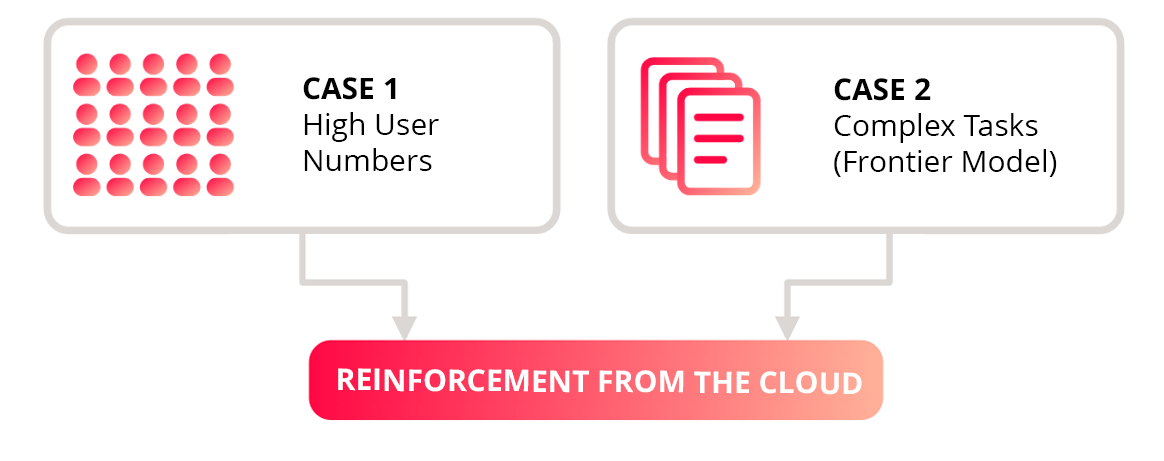
Case 1: High user numbers when everyone makes a request at the same time
When many users send requests at the same time, a local server quickly reaches its limits, especially when usage fluctuates widely. Dedicated hardware would have to be sized for peak times and would sit idle the rest of the time. In the cloud, it’s different: Capacity scales up as demand increases and is released again when demand drops.
Case 2: Complex tasks requiring frontier models
Some tasks are too complex for smaller models—for example, specialized legal texts, very long documents, or questions that require multiple steps of reasoning. Frontier models are designed for such cases. These are the most powerful models offered by major AI providers—that is, the strongest variants each provider has in its portfolio. They are characterized by exceptional capabilities in reasoning and handling complex content. Providers such as OpenAI, Google, Anthropic, and Mistral offer such models. Because they require a great deal of computing power, they are typically run in the cloud.
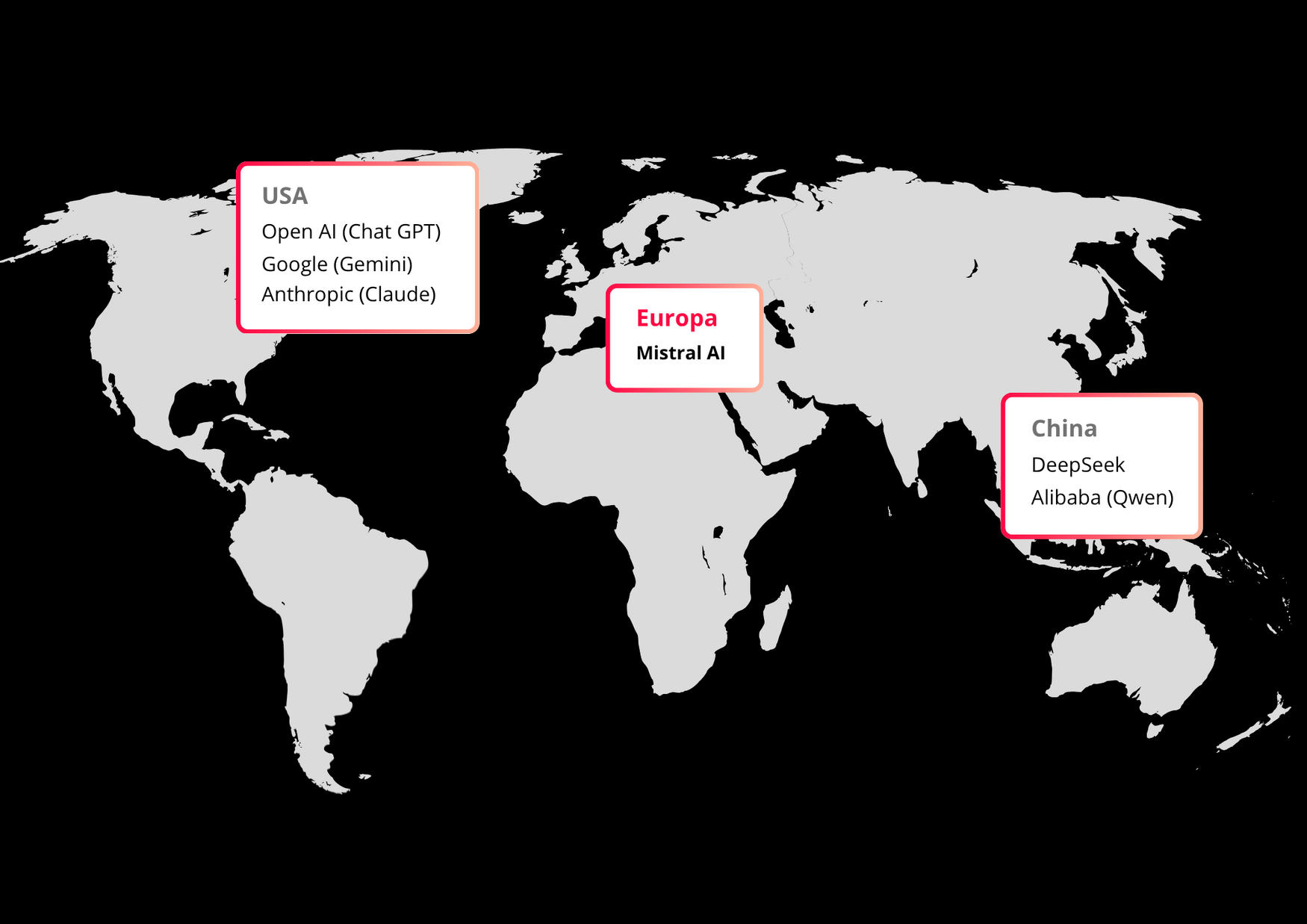
Cloud AI from Europe, China, or the U.S.: What This Means for Your Data
"72 percent of German citizens believe Germany is too dependent on the U.S. when it comes to AI, and 65 percent would like to see AI developed within the EU."
If either of these two scenarios applies, the next step is cloud AI. But not all clouds are the same. Where the provider is based and which laws it is subject to make a big difference when it comes to protecting your data.
Cloud AI from China: DeepSeek and Alibaba
If either of these two scenarios applies, the next step is cloud AI. But not all clouds are the same. Where the provider is based and which laws it is subject to make a big difference when it comes to protecting your data.
Cloud AI from the U.S.: ChatGPT, Gemini, and Claude
Many well-known cloud AI providers are based in the U.S.: OpenAI with GPT, Google with Gemini, and Anthropic with Claude. Their infrastructure can handle large numbers of users, and they offer a wide range of models, including Frontier models. However, from a data protection perspective, it is important to note that these companies are subject to U.S. law, including potential disclosure requirements under the CLOUD Act. This may also apply to data stored in data centers in the EU. Therefore, a European server location alone does not preclude such access.
Cloud AI from Europe: Mistral AI and German Cloud Infrastructure
There are also providers of frontier models in Europe. One of the best-known is Mistral AI from Paris. In early October 2026, the company released Mistral Large 4—also known internally as “Le Chonk”—a frontier model with one trillion parameters, and also offers Le Chat, a European alternative to ChatGPT. As a European provider, Mistral operates within the legal framework of the GDPR and the EU AI Act.
Mistral’s models can be accessed directly via the company’s own infrastructure or through European cloud providers such as STACKIT, IONOS, or T-Systems, which operate them in German data centers. This allows for EU-compliant hosting to be combined with European frontier models, which are generally not part of the aforementioned cloud providers’ own offerings.
RAG: How AI Works with Your Documents Without You Having to Hand Them Over
For a model like Mistral to work with corporate data, that data doesn’t have to be moved entirely to the cloud. That’s where RAG (Retrieval-Augmented Generation) comes in: The documents remain in the organization’s own environment, are broken down into sections, and made searchable. Only when a specific request is made is relevant content passed to the model as context.
RAG is like taking a test with the book open: The AI model doesn’t have to memorize the company’s policies; it just needs to know which page to look up.
Furthermore, a RAG application works just as well with local AI as it does with cloud AI, so both can be combined or switched later on.
Mistral and RAG: What are the benefits of this combination?
The Mistral-RAG partnership combines computing power with data sovereignty: Mistral handles the complex tasks and peak workloads, while RAG ensures that only the necessary data segments leave the organization. What this means in practice:
- Your data remains under your control: The knowledge base stays within your own environment. Mistral sees only the data segments necessary for the specific query.
- Capacity scales up as needed: As the number of requestsincreases , the cloud provides more capacity without requiring you to invest in your own hardware.
- EU law applies: As a model provider,Mistral is subject to the GDPR and the EU AI Act. This applies regardless of which cloud infrastructure is used to run the model.

Checklist: When Does On-Premises AI Work, and When Is Cloud AI Needed?
Local AI works for:
☐ internal use, predictable number of users
☐ particularly sensitive dat
☐ standard tasks such as search or summarization
Local AI + European cloud AI is useful for:
☐ significant fluctuations in usage or peak load
☐ local hardware that reaches its limits during peak time
☐ complex tasks: long documents, technical texts, multi-step reasonin
☐ External users such as customers or member
☐ Availability that is required around the cloc
☐ Data that must remain within the scope of European law
If any of the items in the second group apply, it is worth taking a closer look at the requirements.
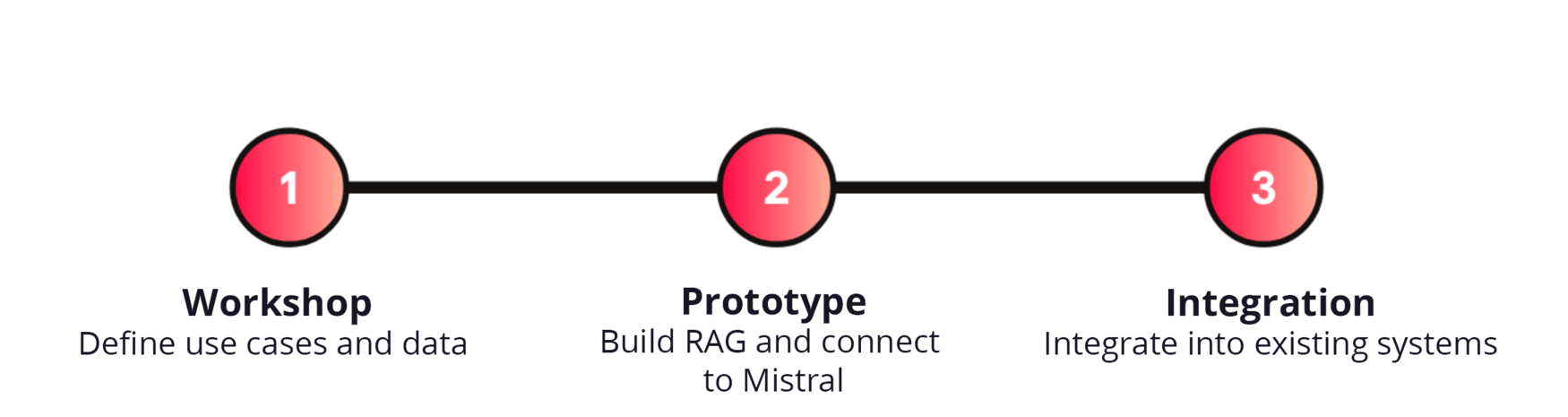
3 Steps to Your Mistral RAG Solution
A typical example illustrates how this works in practice: An organization offers its members an AI assistant that answers questions based on the organization’s own documents. Usage varies greatly, so setting up local infrastructure would not be cost-effective.
- Workshop: Use cases , documents, and requirements for data protection and scalability are clarified.
- Prototype: The knowledge base is built, the RAG application is set up, and it is connected to Mistral. Initial tests verify whether the answers are correct.
- Integration: The solution is integrated into existing systems. Users receive answers from official documents, with a link to the source.
Conclusion: Local and European cloud AI complement each other
Local AI and European cloud AI are not mutually exclusive; they complement each other. Which combination makes sense depends on the specific case: on the number of users, the tasks, and the data protection requirements. There is no one-size-fits-all solution, but there is an approach that addresses the specific case: first understand the requirements, then decide.
It’s important to note: Whether Mistral with RAG is the right choice for a specific case can only be determined after a close examination of the requirements. That’s why we always start with a workshop where we work together to assess whether and how the solution fits the situation. If it doesn’t, we’ll say so openly.