Secure AI for businesses: Information and resources
Here you will find guides, use cases and technical background on using AI securely in your company: from rules and data protection to your own AI software.
- Guide: using AI securely and in line with the GDPR
- Identify AI use cases in your company
- Technical deep dives on local LLMs, RAG and more

Secure AI in a company means: confidential data is protected, access is controlled, legal requirements such as the GDPR and the EU AI Act are met, and a person checks the results before they have consequences.
This AI hub brings together practical knowledge on the secure and responsible use of AI in companies: rules for employees, data protection, information security and choosing the right operating model. You will also find white papers, use cases, webinars and technical deep dives.
Five building blocks for secure AI in your company
1. Rules instead of bans
A plain ban usually leads to shadow AI: employees use private accounts, and nobody knows which data goes where. A better approach is an AI policy that defines which tools may be used for which data. Training is part of this: since February 2025, the EU AI Act has required companies to ensure sufficient AI literacy among their staff. Our AI training by makandra academy offers suitable formats.
2. Data protection and GDPR
Not all information needs the same level of protection. A simple data classification shows which content may go into a cloud AI and which should not leave the company. Personal data requires a data processing agreement, and for trade secrets that is often not enough. Read more in our article AI and data protection.
3. Information security
An AI application needs the same safeguards as any business-critical software: a role and permission concept, single sign-on, audit logs, monitoring and isolated infrastructure. It is important that the AI only sees documents the person asking already has access to.
4. The right operating model
For non-critical tasks, cloud AI may be enough. A sovereign cloud keeps the data in the EU, but the model stays with the provider. Companies that work with trade secrets or regulated data rely on local AI in business: the model and data run on their own servers or in a German data center. Our comparison of cloud solutions and local AI shows how Copilot, ChatGPT and the like differ from a local solution.
5. Quality and human oversight
Language models can state false information very convincingly. Secure AI therefore provides answers with source references, is tested with real data and has clear rules on when a person approves the result.
Are you still at the beginning of your AI journey?
We help you get started with secure and proprietary AI. Read our AI white paper or explore our AI strategy and consulting services. If you’re considering building your own AI solution – for example, to use AI securely with sensitive data or to automate complex processes – we’ll support you from idea to implementation.


AI strategy and consulting
For companies that want to use AI securely and responsibly: We advise you on the use of local language models and work with you to develop customized solutions that run in Germany or on your own infrastructure.
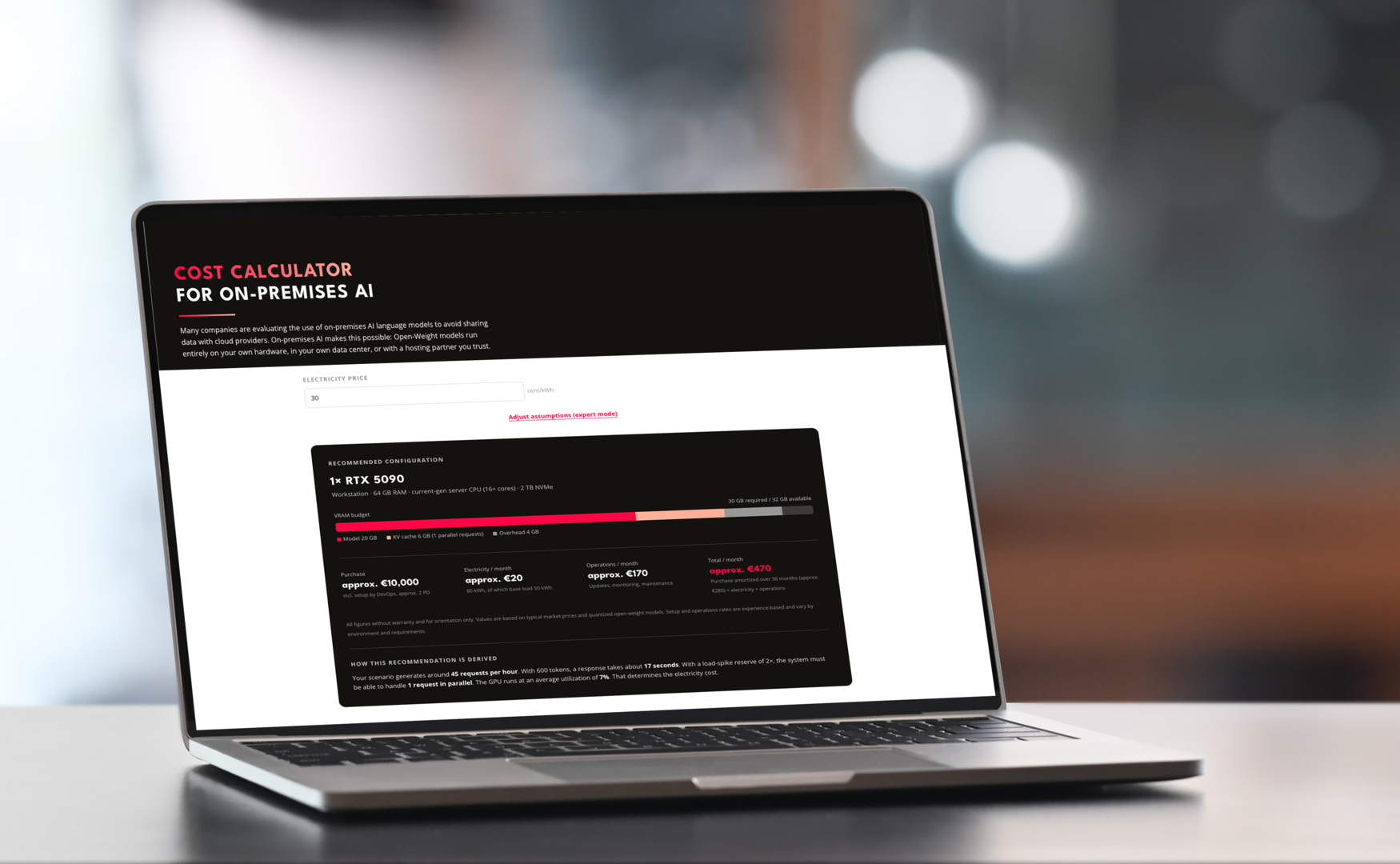
Your path to secure AI in your company
Our resources help you identify the right AI use case for your business. Can AI support or automate key parts of your operations? We’ll find out together.

Three use cases for your own AI
The discussions we have with customers reveal a clear pattern: With local AI, three typical AI use cases emerge that usually bring noticeable benefits quickly:
- Search: How can I find internal knowledge more quickly?
- Document creation: How can I create repeatable documents?
- Content analysis: How can I quickly extract information from PDFs/emails?

Magazine: Successful AI projects
Identify AI potential and secure the benefits immediately: Our magazine offers useful insights into practical examples–from efficient AI searches with OpenSearch to document generation. Gain valuable knowledge from our work and discover how your company can benefit from these experiences.

Webinars on AI
In our webinars on AI and local AI, we provide practical insights into how companies can effectively use AI. Learn where AI can add value in your organization, with real-world examples.

Secure AI deployment in SMEs
AI is already a major topic in small and medium-sized enterprises, but its widespread use is still in its infancy. This article provides guidance and assistance based on our experience in implementing AI projects for small and medium-sized enterprises.





















How to recognize a secure AI solution

Local LLM: The technology behind the scenes
Using AI securely and in compliance with data protection regulations – with local LLMs: In our blog post, we show you how to build your own AI with a local LLM and RAG. We also provide insight into the development of our proof of concept: makandra AI.
FAQs about the secure use of AI in companies
Secure AI protects confidential data, controls access, meets legal requirements such as the GDPR and the EU AI Act, and has people check the results. This applies to the software used as well as to rules and training for employees.
Only with clear rules. With private accounts, the company has no control over how prompts are stored and used. Even with business plans, the data is processed by the provider. Personal data and trade secrets should therefore only go into tools that your AI policy approves for this purpose and for which a data processing agreement is in place.
Yes. An AI policy defines which tools are allowed, which data may be used and who checks the results. It protects against shadow AI and is the basis for training and for agreement with data protection officers and the works council.
Since February 2025, companies that use AI have had to ensure sufficient AI literacy among their staff. Further obligations depend on how risky an application is classified: for most internal applications they are manageable, while high-risk systems are subject to strict requirements on documentation, quality and human oversight.
Security in AI is not there automatically, but it can be controlled.
Important building blocks:
- Role and permission concept (who is allowed to do what?)
- SSO and identity management
- Data classification (which data may be used?)
- Audit logs and monitoring
- Isolated infrastructure and network segments
- Rate limits and abuse protection
With local AI, all of these building blocks are in your hands. This makes it particularly suitable for regulated industries, companies with works council and compliance requirements, and sensitive internal workflows.
When the AI is to work with trade secrets, personal data or regulated data. In that case, the model and data stay on your own servers or in a German data center. We explain what this means in detail and where the limits are in our article Local AI in business.
Start your secure AI project with us

Fabian Rimpl | CEO
Are you ready to start your own AI project? We would be happy to provide you with a customized quote for your company's AI or advise you on your options and our packages.