AI-Powered Search for Jacobi + Klimasch
makandra developed an AI-powered search for Jacobi + Klimasch Sachverständige that lets employees ask questions about the entire document base in natural language and receive answers backed by their sources. The language model, search index and documents run exclusively on servers operated by makandra.

Jacobi + Klimasch Sachverständige, based in Achim near Bremen, is one of the leading firms of loss assessors in northern Germany. Since its founding in 2010, the company has assessed damage to buildings, household contents, business contents and business interruption on behalf of insurance companies, with a focus on fire, water, storm and burglary losses. The company employs around 40 people.
makandra developed an AI-powered application that lets the team search its entire document base in natural language.
5,000 documents searched in 2 minutes
Challenge
Knowledge from more than 15 years is spread across thousands of files and can only be found with the exact search term
Solution
Local AI search that answers natural-language questions and cites its sources
Industry
Technology
Services
makandra listened to us from the very beginning and understood what really matters to us. The team is technically strong, works reliably and delivers on its promises. We felt in good hands and would gladly take on our next project with makandra as well.
Key Challenges
At Jacobi + Klimasch, expert knowledge, reports and guidelines are spread across thousands of files. Anyone who needed a piece of information had to know which document contained it and then work their way through that document. The goal was a solution that delivers answers without employees having to know where things are stored.
- Search required prior knowledge
Anyone looking for a specific topic had to already know the exact term the classic full-text search would look for. The result was a list of hits that still had to be worked through. - A document base grown over more than 15 years
The workforce has multiplied since the company was founded, and office space doubled in 2024. The document base has grown along with the company. - Confidentiality as a hard requirement
Jacobi + Klimasch works with sensitive claim documents every day. The requirement was clear: processing must take place locally, on controlled servers, not with some arbitrary provider on the internet. - Answers must be verifiable
Loss assessors are accountable for their findings to insurers and policyholders. That is why it was clear from the start: an answer is only usable if it can be traced back to the document it came from.
Our Solution for Jacobi + Klimasch
We developed an AI-based application for Jacobi + Klimasch that answers questions about the company’s own documents, without employees having to know where they are stored.
- Questions instead of keywords
Employees describe what they need in their own words. The application translates the input into the terms under which the information is stored and composes a coherent answer from the documents it finds. - Every answer shows its sources
For every answer, the application lists the reference documents it is based on, including the path to the original on the network drive. The files can be downloaded directly from there. - A custom knowledge base made of files
Jacobi + Klimasch decides freely which documents become part of the knowledge base. Uploaded files are automatically read and prepared for search. - Processing exclusively on controlled servers
Documents, search index and language model run on servers operated by makandra itself. The documents never leave this infrastructure.
Today, the application is in daily use at Jacobi + Klimasch across all teams. A search that used to take ten minutes now takes one to two minutes.
2
Previously 10 minutes
5000
searchable by asking in your own words
0
leave the data center
Technical Implementation
The application is built with Ruby on Rails, based on Rails 8.1 and Ruby 3.4. The interface uses Unpoly 3.12 and ViewComponents, while esbuild and pnpm handle asset building.
The text content of every uploaded document is extracted and indexed in OpenSearch 3. Search runs in three steps. First, a language model translates the natural-language question into keywords. OpenSearch then uses these keywords to run a full-text search across the document base. Finally, the documents found are passed together with the original question to a second language model, which composes the answer. The application also shows which documents were used.
Because we operate the application ourselves, we were able to plan a dedicated server for the search index from the start. Development and operations come from a single source, without coordination across system boundaries.
This project has shown that a local AI fits into our familiar ecosystem just as naturally as any other service we have been using for years.
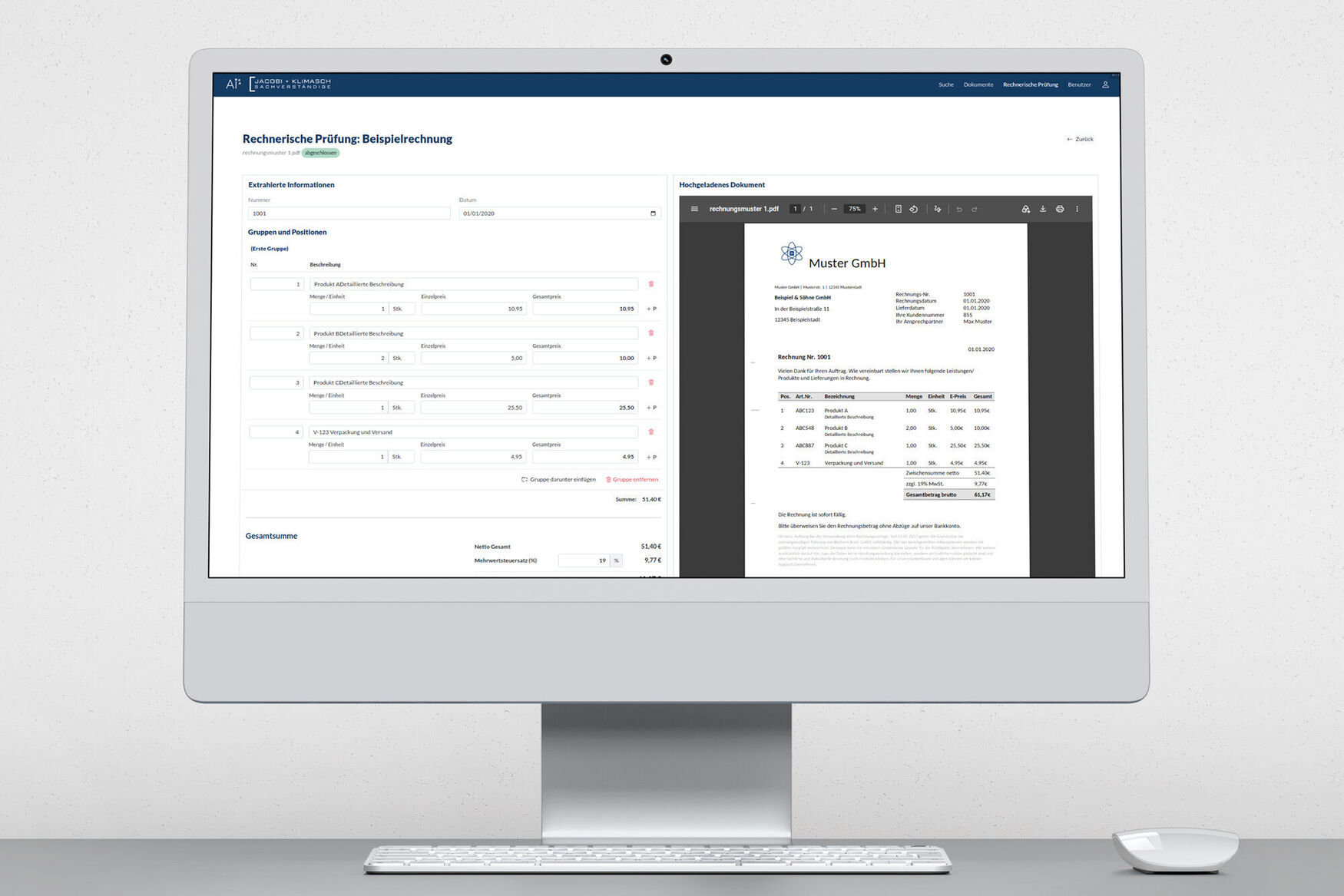
The same application also checks invoices
Alongside search, the platform also captures line items from invoices and quotes, using the same interface and the same infrastructure.
Hosting and Operations
makandra takes full responsibility for operating the application. It runs on our own infrastructure in a German data center, on a high-availability setup of two servers for the web application and the search index, complemented by a database cluster. If one component fails, the other takes over.
On top of that comes our proactive management: we review monitoring alerts, apply security updates, check the backups and keep an eye on server load.
For Jacobi + Klimasch, operating costs stay predictable. The monthly flat fee fully covers the application servers and the database, and there are no usage-based costs for the search functions. This makes it clear from the outset what operation will cost, regardless of how intensively the team uses the application.
Our Services for Jacobi + Klimasch
